
Leadership
Where Does AI Actually Fit?
The question is not whether AI can do a given thing. It is whether a particular piece of work has the shape where AI beats what you do today — a gate, a map, and four quadrants for sorting tasks, not businesses.
In most boardrooms the question about AI is some version of "how do we use it." The more useful question is narrower and harder: across everything you run, where does it actually fit.
The problem is almost never whether AI can do a given thing. The problem is whether a particular piece of work has the shape where AI beats what you do today. What follows is one way to look at the whole business and sort it.
Two questions, in order
Every AI decision is really two questions, and leaders get into trouble by merging them.
The first is a gate. Does this work qualify for AI at all? We call it a gate because it comes first and because it can stop a task cold, though in truth the checks behind it are risk dimensions you weigh together rather than a single pass-fail line. The bar rises with the stakes.
The second is a map. If the work qualifies, where does it belong, and what does that placement demand of you? This is a matter of degree.
The gate
Four checks decide whether a task qualifies, and each one is a question a leader can answer without a technical team. The first three are really facets of one deeper question, which is whether you can catch the system when it is wrong. We keep them separate because each is a distinct way to be caught off guard.
What does a wrong answer cost when nobody catches it? A mistake someone spots is cheap. A plausible wrong answer that flows downstream unchecked is the real exposure.
Can the output be verified cheaply? A human or a system has to be able to confirm the result, or you cannot trust it at the volume you intend to run it.
Is the work reversible? If a bad answer slips through, you want to be able to walk it back, rather than have it fire something you cannot undo.
The fourth check is a different question altogether, which is whether you can teach the system what right looks like. Do you have ground truth? You need a reliable record of the right answer, or a cheap way to create one, both to build against and to measure.
Sitting over all four is a single rule worth stating once: the model is the easy part. None of this works unless someone in the organization owns the change, agrees on what correct means, and wires the output into how work actually gets done. A task that fails the gate is a finding, not a failure.
When the check a task fails is ground truth, ask one more question before you set it aside, because the answer changes everything. Is the data thin by the nature of the business, or thin by choice? An event that is genuinely rare or an instance that is truly one of a kind will never throw off a dense history, no matter what you do, and that task stays where it is. But data is often thin only because the work happens every day and nobody ever captured it. A sales team that closes deals all week but never logs why a prospect said no has thin data by neglect, not by nature. That distinction decides whether the task is permanently parked or one measurement project away from qualifying, and it means your position on the map is partly a choice rather than a fact. You can influence where a task sits by deciding to measure what you have been letting pass.
The map
For the work that clears the gate, the map has two axes, and both are things a leader can judge without an engineer in the room.
The first is the data foundation: how much usable data the work already throws off, running from thin or borrowed at one end to rich and proprietary at the other. The second is the task structure: whether the work is a repeating pattern or a genuine judgment call, running from repetitive to sparse.
One thing is deliberately left off the map, and naming the omission matters. The size of the prize is not an axis. It is the tiebreaker you reach for once tasks are placed, when two of them sit in the same quadrant and you have to choose. Value per instance multiplied by how often the work happens will break that tie. It does not belong on the map itself, because a large prize in the wrong quadrant is still the wrong place to start.
The four quadrants
The two axes produce four quadrants, and each one asks something different of the leader.
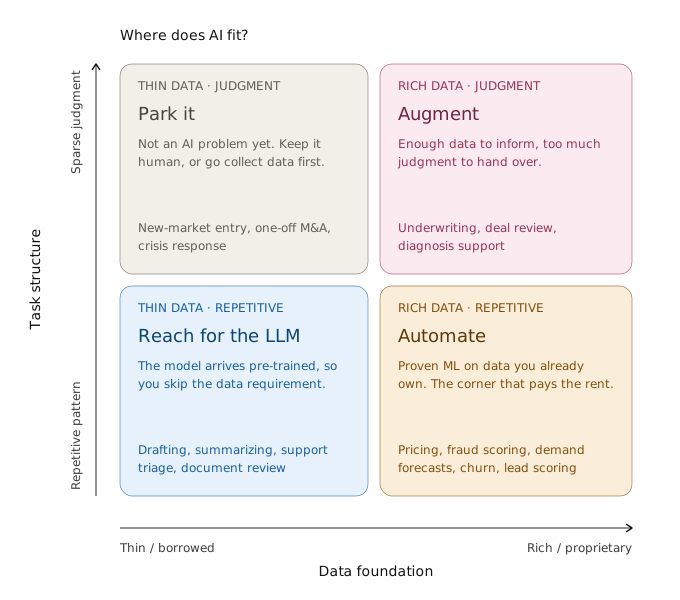
Automate is the corner where you hold rich, proprietary data and the work repeats at volume. This is the engine room, and the tool is usually classical machine learning rather than a language model. Demand forecasting and inventory planning, dynamic pricing, fraud and anomaly detection, credit and collections scoring, churn prediction, lead scoring, predictive maintenance on equipment that throws off sensor data all live here. The posture is to fund it and protect it. This quadrant pays the rent quietly, rarely makes headlines, and is where the most durable and defensible margin sits.
Augment is rich data paired with judgment. You have the history, but the final call carries too much context or consequence to hand over, so the model informs and the human decides. Underwriting, medical and diagnostic decision support, investment and deal review, legal contract review, complex claims adjudication, a radiologist reading flagged scans all belong here. This is where the choice between augmenting a person and replacing one gets made deliberately. The posture is to find your strongest judgment-makers and equip them, rather than spreading a generic tool thinly across everyone. A monkey in a Ferrari does not win a race; your best performer in that same seat pulls away from the field.
Reach for the LLM is the one quadrant where you can move now without a data project. The work is repeating and language-shaped, you lack proprietary training data, but the model arrives already trained on the patterns of the world, so you skip the data-building step entirely. Drafting and summarizing routine communications, first-pass document review, customer support triage and routing, meeting notes and action items, turning dense reports into plain language all fit here. The posture is to recognize this as the exception that makes AI feel easy. The other three quadrants demand a data foundation; this one does not, which is exactly why it misleads people into expecting AI to work everywhere with no groundwork.
Park it is thin data and sparse judgment, where you have neither the proprietary history nor a repeating pattern. Setting corporate strategy, entering a new market for the first time, a one-off acquisition negotiation, pricing a genuinely new product with no comparable history, crisis response all sit here. The posture is to resist forcing it. Decide whether to keep the work fully human, or whether it is worth investing in the data and process that would move it onto the map later. Forcing AI into this corner is how shiny pilots get built and quietly abandoned.
The map moves
A task is not fixed where it lands today. We saw this already with thin data, where a deliberate choice to start measuring can move a task from left to right on the map. The same is true vertically. The map is a snapshot of a moving picture, and the most useful thing a leader can do with it is plan the movement.
The common path runs from augment to automate. You begin by pairing a model with your best people on a judgment-heavy task. As they work, the pairing generates a labeled record of what good judgment actually looked like, decision after decision. Over time that record becomes the data foundation the task never had, and the work drifts toward the automate corner until full automation becomes possible. Placing a task in augment today is often how you earn the right to automate it later. Read this way, the map stops being a sorting exercise and becomes a sequencing strategy, which is a decision about how you time capital rather than how you categorize work.
Sort tasks, not businesses
The most common mistake leaders make with a framework like this is to apply it at the wrong altitude. They ask whether a whole business or a whole function should use AI, and they get stuck, because no business sits cleanly in one quadrant.
A single function splits. Take customer contact. The routing of an inbound query and the summarizing of a call are repetitive and well-suited to automation. The moment a skilled person talks an unhappy customer out of leaving is judgment, and you augment it rather than hand it over. One function, two quadrants, two different decisions. The skill is decomposition: breaking the work down finely enough that each piece places itself on the map. The businesses that stall are the ones that tried to automate an entire function and broke the part that needed a human, or automated none of it and wasted the part that did not.
One lens among several
This is one way to look at AI, and it is worth being honest that there are others. You could sort by broad-domain models against narrow ones, by whether your data is a genuine moat, by whether the system runs on its own or assists a person. Each lens is useful somewhere.
This is the lens that matters most at the altitude a board and a chief executive operate at, where the questions are where to point attention and where to commit capital. As you descend into the detail of any single function, the lens sharpens and changes, and the people building the system will need finer tools. This map is built for the people who set the mandate.
The one thing a leader cannot delegate
The appeal of AI is that it lets you delegate execution. You can hand a pricing calculation, a routing decision, or a first-draft analysis to a machine and let it run, and for the right work that is exactly what you should do. What you cannot hand off is the decision of what to delegate, to what extent, and whether the organization is ready to act on the result. That judgment sits above every quadrant on the map, and it stays with you.
The map does not make the decision for you. It is what lets you make it well. So take one function this week, break it into the real tasks underneath it, run each through the gate, and place the ones that survive. Then decide, deliberately, which executions you are willing to hand off and which decisions you intend to keep. That last act of judgment is the job. The map only shows you where to point it.